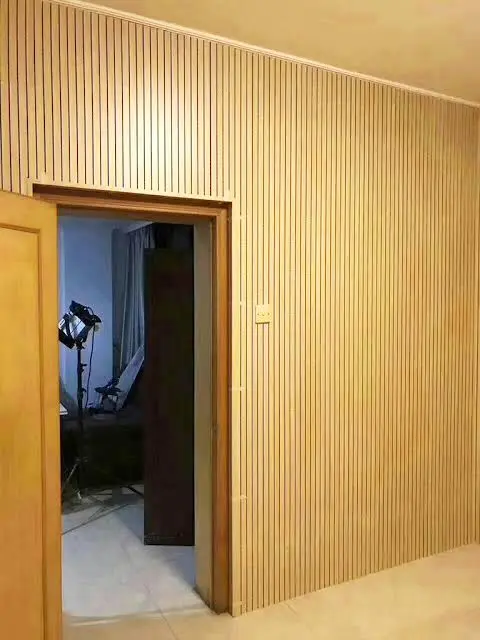
Wood panels offer more than just visual interest in a space. Products such as those from WoodUpp combine design with an acoustic felt backing to help manage sound in everyday environments. Instead of serving solely as decorative elements on walls or ceilings, these panels absorb and diffuse echo and reverberation. This can make conversations clearer and contribute to a calmer atmosphere, whether at home or in an office setting.
A variety of finishes and sizes are available, allowing for stylistic flexibility while also improving the acoustics and overall comfort of a room. Each panel is 22 mm thick: 13 mm MDF lamellas carrying the veneer sit on 9 mm of acoustic felt, with 27 mm wide slats set 13 mm apart.
How wood panels affect sound in your space
Wood panels provide benefits beyond their warm and inviting appearance. Acoustic felt placed behind each wooden slat helps absorb airborne sound waves, which reduces echo and makes speech easier to understand. This also leads to a decrease in background noise.
The result is a less harsh acoustic environment, making rooms feel more comfortable and pleasant. The combination of wood slats and felt backing can shorten reverberation times, which is particularly useful in spaces with many hard surfaces, such as kitchens, living areas, or meeting rooms. Reverberation time is the time it takes sound to decay by 60 dB after the source stops; ASHRAE guidance uses 0.6 seconds as a limit for furnished offices and conference rooms, and living rooms are commonly planned for about 0.4 to 0.6 seconds.
When properly installed, wood panels can absorb significant amounts of incoming sound energy, reducing reflections and helping to create a quieter environment. Fixed straight to the wall with adhesive or screws driven through the felt, WoodUpp’s panel is rated absorption class D under EN ISO 11654; on 45 mm battens with 45 mm of mineral wool behind it, the tested build reaches class A.
Choosing the right panel for your needs
Selecting acoustic wall or ceiling panels involves considering both design and function. WoodUpp’s Akupanel systems are produced in standardized sizes and slat dimensions, allowing for straightforward integration into various spaces. Panels are available in lengths around 240–300 cm and widths of 60 cm, plus a 60 × 60 cm format, with thicknesses that include both the felt and wood components.
It may be helpful to choose a finish that complements the existing interior. Options range from natural veneers to colored surfaces or wood-look foils, accommodating different design preferences. The felt backing not only manages sound but can also add visual depth to each panel.
Placement plays an important role in effectiveness. Panels are often installed on larger wall sections or ceilings where sound tends to reflect most. A practical starting point is absorbers on about 15 to 25 percent of the wall area, placed at the first reflection points on the side walls and spread over two adjacent walls rather than one. Careful selection and positioning can enhance both the style and acoustic comfort of a room.
Real-world uses for acoustic panels at home and work
Acoustic wood panels fit well into a variety of settings. In home cinemas or TV rooms, they can improve sound quality by reducing echo from hard surfaces. Offices often use them to minimize background noise in meeting rooms, making conversations clearer.
Kitchens frequently benefit from these panels because their many flat surfaces can amplify sound. Studios and classrooms may also experience improved clarity with this type of acoustic treatment.
With panels designed to address both aesthetic and acoustic considerations, it is possible to create spaces that are coordinated in appearance and comfortable for daily activities. This approach supports adaptable environments in both homes and workplaces. The panels reduce reflections within the room; they do not provide sound insulation between rooms, which depends on the wall or floor structure.