Learning the drop off meaning can save you from confusion because this common English phrasal verb has several different uses depending on the situation.
You may hear someone say they need to drop off a package, drop off the kids at school, or even sales dropped off last month.
Although the words stay the same, the meaning changes with context.
This guide explains every major meaning of drop off meaning, where it came from, how native English speakers use it today, common mistakes to avoid, and dozens of natural examples.
Whether you’re learning English, improving your vocabulary, or simply curious, you’ll find everything you need here.
Quick Answer Box
| Topic | Answer |
|---|---|
| Meaning | “Drop off” is a phrasal verb with several meanings, including delivering someone or something, falling asleep, decreasing, or becoming less. |
| Definition | To leave someone or something at a place, to fall asleep, or to decline gradually. |
| Context | Everyday conversations, transportation, business, education, logistics, and casual English. |
| Usage | “I’ll drop off the package.” “He dropped off during the movie.” “Sales dropped off in winter.” |
| Tone | Neutral and conversational. |
| Formal or Informal | Mostly neutral and suitable in both spoken and written English. |
| Alternative Meanings | Delivery, sleeping, reduction, decline, or ending depending on context. |
What Does Drop Off Mean?
The drop off meaning depends entirely on how it is used in a sentence. Unlike many English words that have just one definition, drop off is a multi-purpose phrasal verb used in daily conversation.
The four most common meanings are:
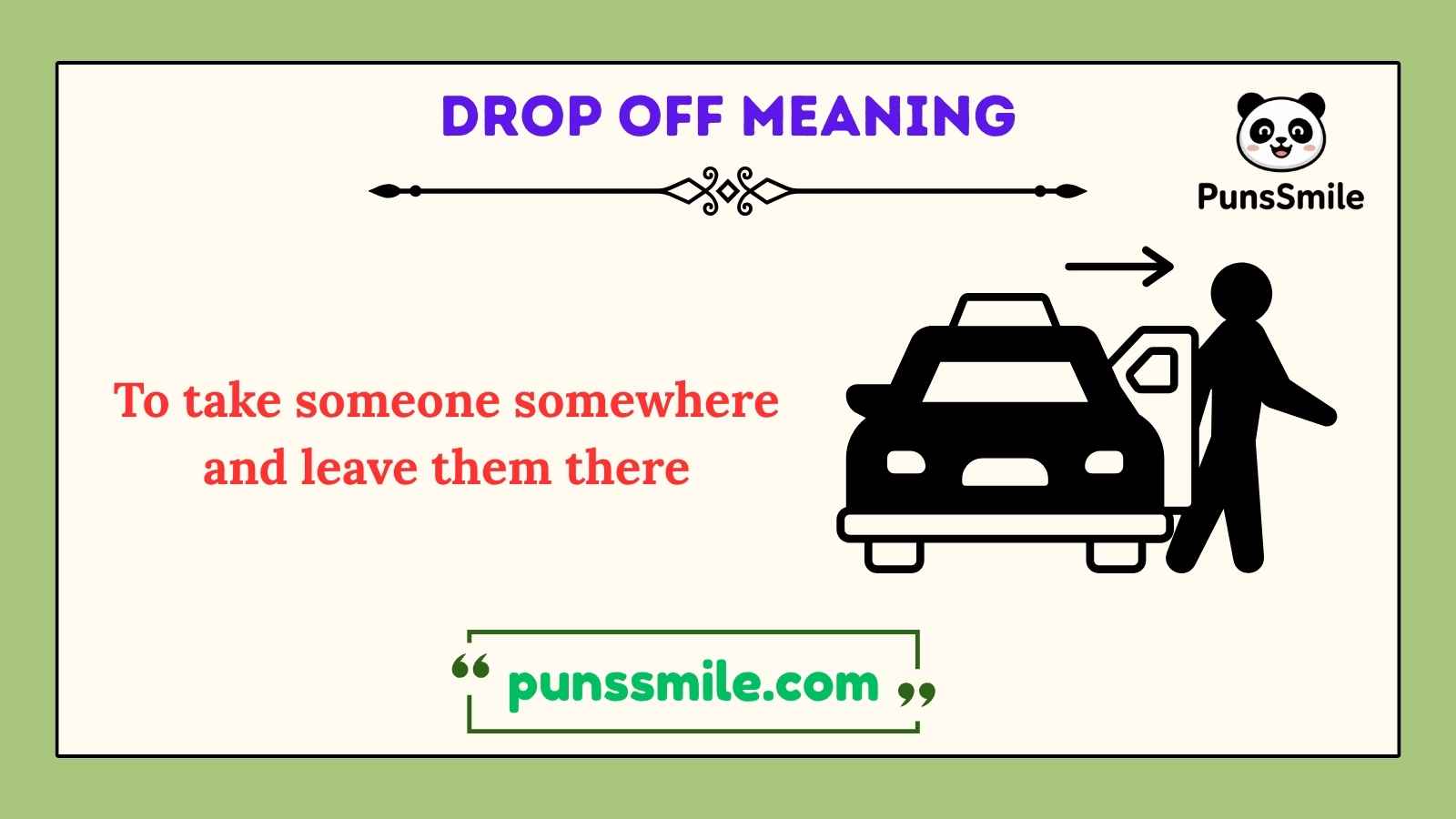
- To take someone somewhere and leave them there.
- To deliver or leave an object.
- To fall asleep.
- To decrease or become less over time.
Because context determines its meaning, native speakers understand it naturally without confusion.
The Most Common Meanings of Drop Off
1. To Leave Someone at a Place
This is the meaning many people learn first.
Examples
- I’ll drop off my daughter at school.
- Can you drop me off at the airport?
- She dropped her friend off after dinner.
In this sense, someone drives or accompanies another person to a destination before leaving.
2. To Deliver Something
Another common drop off meaning is leaving an object somewhere.
Examples
- I’ll drop off your books tomorrow.
- Please drop off the documents at reception.
- The courier dropped off the package this morning.
This meaning is widely used in delivery services and everyday errands.
3. To Fall Asleep
In casual English, drop off also means to fall asleep naturally.
Examples
- I dropped off while watching TV.
- The baby finally dropped off after crying.
- He dropped off during the lecture.
This use often refers to falling asleep unintentionally or gradually.
4. To Decrease or Become Less
Businesses, teachers, journalists, and economists often use drop off to describe a decline.
Examples
- Attendance dropped off after the holidays.
- Sales dropped off during the winter.
- Interest in the topic gradually dropped off.
This meaning describes a noticeable reduction over time.
Origin and History of Drop Off
The phrase drop off developed from the literal verb drop, meaning to let something fall, combined with the preposition off, which often indicates separation or movement away.
Over time, English speakers expanded the phrase into figurative meanings. Instead of physically dropping something, people began using it to describe leaving people at destinations, falling asleep, or gradual declines.
Today, drop off is one of the most frequently used English phrasal verbs.
How Native English Speakers Use Drop Off
Native speakers use drop off naturally in many situations.
Transportation
- I’ll drop you off at work.
- Dad dropped us off at the station.
Delivery
- She dropped off the groceries.
- The driver dropped off our order.
Sleep
- I dropped off before finishing the movie.
- He dropped off almost instantly.
Business
- Website traffic dropped off this month.
- Customer inquiries have dropped off recently.
Drop Off Meaning in Different Situations
| Situation | Meaning | Example |
|---|---|---|
| Driving | Leave someone somewhere | I’ll drop you off downtown. |
| Delivery | Leave an item | Please drop off the package. |
| Sleep | Fall asleep | I dropped off after lunch. |
| Business | Decline | Sales dropped off this quarter. |
| Education | Decrease | Student participation dropped off. |
| Sports | Performance declined | His speed dropped off late in the game. |
Drop Off vs Similar Phrasal Verbs
| Phrase | Meaning | Difference |
|---|---|---|
| Drop off | Leave, deliver, sleep, decrease | Multiple meanings depending on context |
| Drop by | Visit briefly | Refers to visiting someone |
| Drop in | Visit unexpectedly | Usually informal |
| Leave | Depart or place something | More general |
| Deliver | Transport something | More formal than drop off |
Common Expressions Using Drop Off
English speakers often combine drop off with different nouns.
Examples include:
- Drop off the kids
- Drop off a package
- Drop off groceries
- Drop off donations
- Drop off paperwork
- Drop off luggage
- Drop off passengers
- Drop off supplies
These combinations are common in both personal and professional settings.
Common Mistakes People Make
Confusing It with “Drop By”
Incorrect:
I’ll drop by the package.
Correct:
I’ll drop off the package.
Using It Without Context
Because drop off has multiple meanings, always provide enough context.
Instead of saying:
He dropped off.
Say:
He dropped off at the airport.
or
He dropped off during the movie.
The surrounding words make the intended meaning clear.
When Should You Use Drop Off?
Use drop off when you want to describe:
- Taking someone to a destination.
- Delivering an item.
- Falling asleep.
- A gradual decrease in numbers, activity, or performance.
It fits naturally in conversations, emails, workplace discussions, and everyday English.
When Should You Avoid Using Drop Off?
Avoid using drop off when you need a more precise or formal verb.
For example:
Instead of:
- The company dropped off the contract.
A legal document may sound clearer with:
- The company delivered the contract.
Similarly, in formal reports, words like declined, decreased, or reduced may be more appropriate than dropped off.
Real-Life Examples with Explanations
Example 1
“I’ll drop off the laundry after work.”
Meaning: Delivering something.
Example 2
“The children were dropped off at school.”
Meaning: Leaving people at a destination.
Example 3
“I dropped off halfway through the movie.”
Meaning: Fell asleep.
Example 4
“Online orders dropped off in January.”
Meaning: Sales decreased.
Example 5
“The volunteer will drop off food this afternoon.”
Meaning: Delivering supplies.
FAQs:
What is the basic drop off meaning?
The basic meaning is to leave someone or something at a specific place. Depending on context, it can also mean to fall asleep or to decrease.
Is drop off a phrasal verb?
Yes. Drop off is one of the most common English phrasal verbs and has several related meanings.
Can drop off mean falling asleep?
Yes. In conversational English, “drop off” commonly means to fall asleep naturally.
Does drop off mean decrease?
Yes. It often describes a gradual decline in numbers, performance, interest, or activity.
Is drop off formal or informal?
It is generally neutral. It works well in everyday conversation and many professional situations, though more formal writing may prefer words like decline or deliver.
What is the difference between drop off and deliver?
Deliver specifically means transporting something to its destination. Drop off is broader and can also refer to taking people somewhere, falling asleep, or declining.
Can I use drop off for people?
Absolutely. Saying “I’ll drop you off at the station” is one of the most common uses of the phrase.
Conclusion
Understanding the drop off meaning is essential because this versatile phrasal verb appears in everyday conversations, workplaces, schools, transportation, and business.
While its meanings vary from leaving someone at a destination to delivering an item, falling asleep, or describing a gradual decline the surrounding context almost always makes the intended meaning clear.
The more examples you read and hear, the easier it becomes to recognize which meaning is being used.
By mastering drop off, you’ll sound more natural in English conversations and better understand native speakers across a wide range of situations.

Rashid Ali is the mind behind Punssmile.com, where confusing slang and viral terms become simple to understand. He loves breaking down text meanings, chat abbreviations, and trending words in a fun, easy way. If you’ve ever wondered what a word really means in a message, you’re in the right place.