The khalifa meaning is often searched by people who encounter the word in Islamic history, Arabic texts, names, or popular culture.
While many recognize “Khalifa” as a surname or title, its original meaning has deep historical and religious roots.
Understanding the word requires more than a simple dictionary definition. Depending on the context, Khalifa can refer to a religious leader, a successor, a personal name, or even a symbolic representative.
This guide explains every major meaning in clear, easy-to-understand language so you can confidently recognize how the term is used today.
Quick Answer Box
| Topic | Answer |
|---|---|
| Meaning | Successor, leader, or representative |
| Definition | An Arabic word referring to someone who succeeds or represents another |
| Language | Arabic (خليفة) |
| Context | Religion, history, names, politics, culture |
| Tone | Neutral and respectful |
| Formal or Informal | Primarily formal |
| Common Usage | Islamic history, personal names, historical titles |
| Alternative Meanings | Caliph, successor, steward, vicegerent depending on context |
What Does Khalifa Mean?
The word Khalifa (Arabic: خليفة) literally means “successor,” “representative,” or “deputy.”
It comes from the Arabic root خ ل ف (Kh-L-F), which relates to the idea of coming after someone or taking someone’s place.
In English, the word is often translated as:
- Successor
- Caliph
- Representative
- Steward
- Vicegerent
- Deputy
The exact meaning depends on how the word is being used.
The Origin and Etymology of Khalifa
Khalifa originates from Classical Arabic and has been used for well over a thousand years.
The root letters Kh-L-F (خ ل ف) carry meanings associated with:
- Coming after someone
- Replacing someone
- Following in succession
- Acting on behalf of another
Because of this linguistic origin, the word naturally developed into a title for someone who succeeds another leader.
Khalifa Meaning in Islam
One of the most important uses of Khalifa appears in Islam.
Historically, a Khalifa (Caliph) was considered the political and community leader who succeeded Prophet Muhammad after his death.
The role was not that of a prophet. Instead, the Khalifa was responsible for:
- Leading the Muslim community
- Protecting Islamic governance
- Preserving unity
- Managing public affairs
- Upholding justice according to Islamic principles
The first four leaders are commonly known as the Rightly Guided Caliphs (Rashidun Caliphs):
| Khalifa | Historical Role |
|---|---|
| Abu Bakr | First Caliph |
| Umar ibn al-Khattab | Second Caliph |
| Uthman ibn Affan | Third Caliph |
| Ali ibn Abi Talib | Fourth Caliph |
These figures remain central to Islamic history.
Khalifa in the Quran
The word Khalifa also appears in the Quran.
In some verses, it refers to humanity being appointed as stewards or representatives on Earth. In another context, Prophet Dawud (David) is described as a Khalifa, meaning a ruler entrusted with justice.
Because of these contexts, scholars may translate Khalifa as:
- Representative
- Steward
- Successor
- Vicegerent
The intended meaning depends on the specific verse and scholarly interpretation.
Different Meanings of Khalifa
The word has several accepted meanings depending on context.
| Context | Meaning |
|---|---|
| Islamic history | Caliph or leader of the Muslim community |
| Arabic language | Successor or representative |
| Religious discussion | Steward or vicegerent |
| Personal name | A respected given name or surname |
| Historical title | Political ruler following another leader |
Understanding the surrounding context is the easiest way to determine the intended meaning.
Khalifa as a Personal Name
Today, Khalifa is commonly used as:
- A first name
- A family name (surname)
- Part of a full Arabic name
Parents often choose the name because it carries positive meanings such as:
- Leadership
- Responsibility
- Honor
- Trustworthiness
- Guidance
Its use as a name does not automatically indicate that the person holds any religious office.
Why Is Khalifa Sometimes Spelled Caliph?
English uses two common forms:
| Arabic | English Form |
|---|---|
| Khalifa | Direct transliteration from Arabic |
| Caliph | Traditional English spelling |
Both refer to the same historical concept.
Modern academic writing often prefers Khalifa when discussing the Arabic word itself, while history books frequently use Caliph.
How Is Khalifa Used Today?
Outside historical discussions, the word appears in many modern settings.
Examples include:
- Personal names
- Family names
- Books
- News articles
- Academic studies
- Religious education
- Historical documentaries
Because of its long history, it continues to carry cultural and historical significance.
Examples of Khalifa in Sentences
Here are some natural examples.
Historical
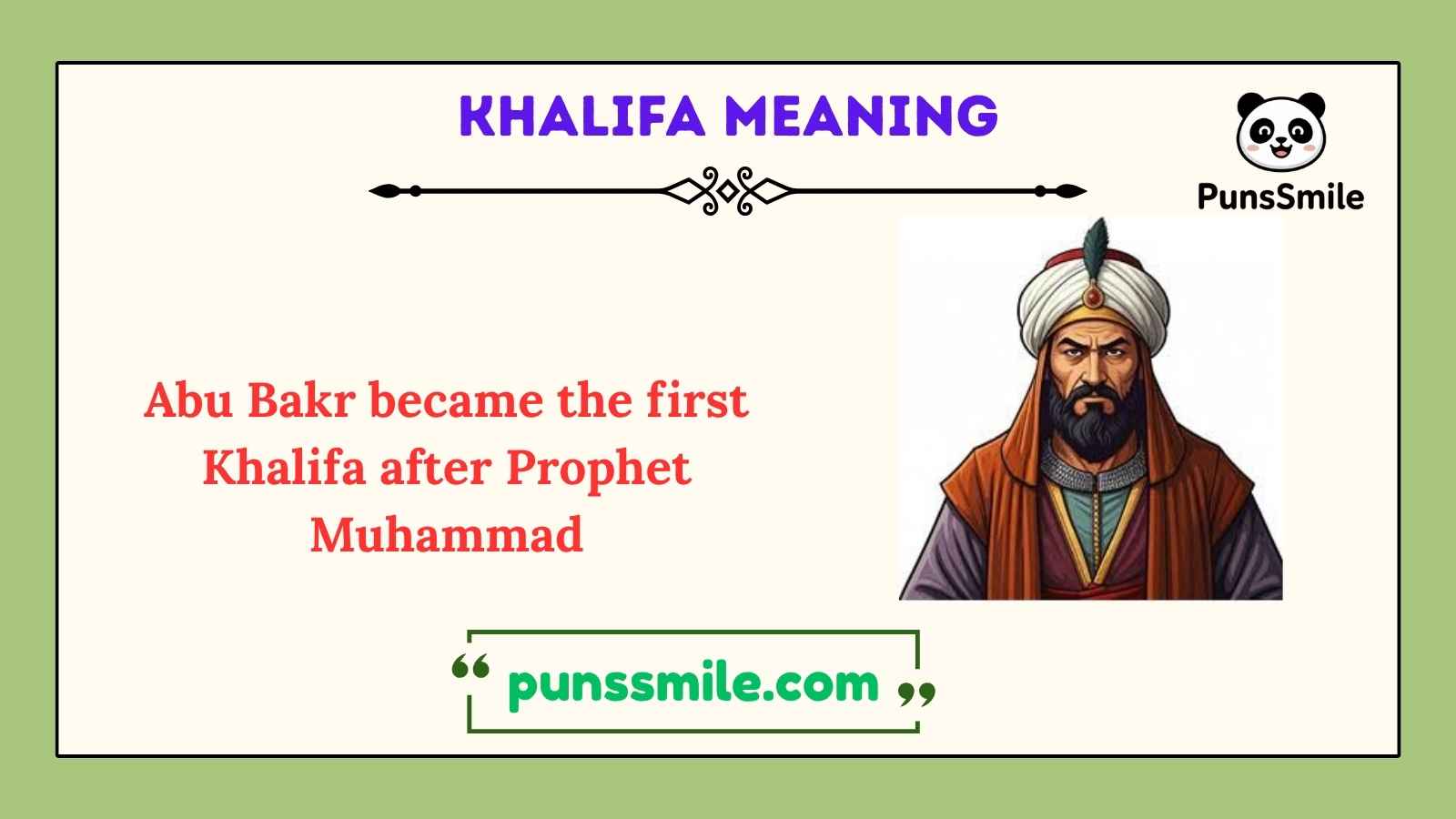
Abu Bakr became the first Khalifa after Prophet Muhammad.
Religious
Some Quranic interpretations describe humans as Khalifa on Earth.
Personal Name
Khalifa is a common name in several Arabic-speaking countries.
Educational
Students learned about the responsibilities of each Khalifa during Islamic history.
Similar Words Related to Khalifa
Several Arabic and Islamic terms are closely connected.
| Word | Meaning |
|---|---|
| Caliph | English form of Khalifa |
| Khilafah | Caliphate or institution of leadership |
| Imam | Religious leader (meaning differs by context) |
| Emir | Commander or ruler |
| Sultan | Monarch or sovereign ruler |
Although these terms may overlap historically, they do not all mean the same thing.
Common Misunderstandings About Khalifa
People often confuse the word because it appears in different contexts.
Here are a few common misconceptions:
Khalifa always means a king.
Not necessarily. While some Khalifas ruled large states, the word itself means successor or representative, not simply “king.”
Every person named Khalifa is a Caliph.
No. Today, Khalifa is widely used as a personal name and surname without implying any official position.
Khalifa is only a religious word.
Not entirely. It also appears in history, politics, language studies, genealogy, and personal names.
When Should You Use the Word Khalifa?
Use the word when discussing:
- Islamic history
- Arabic language
- Historical leadership
- Religious studies
- Arabic names
- Cultural discussions
Choose the meaning that matches the surrounding context.
When Should You Avoid Using It Incorrectly?
Avoid using Khalifa:
- As a synonym for every Muslim leader.
- To describe modern political leaders unless the title officially applies.
- Without understanding whether it refers to a historical office, a personal name, or the Arabic word itself.
Using the correct context helps avoid confusion.
Khalifa vs Caliph
| Feature | Khalifa | Caliph |
|---|---|---|
| Language | Arabic transliteration | English translation |
| Meaning | Successor or representative | Successor or representative |
| Usage | Arabic studies and modern transliteration | English historical writing |
| Pronunciation | Similar | Similar |
Both words refer to the same concept.
FAQs:
Is Khalifa an Arabic word?
Yes. Khalifa is an Arabic word that means successor, representative, or deputy.
Does Khalifa mean king?
No. Although some Khalifas ruled large empires, the word itself does not simply mean “king.”
Is Khalifa mentioned in the Quran?
Yes. The Quran uses the word in contexts referring to stewardship, succession, and leadership.
Is Khalifa a common name?
Yes. Khalifa is a widely used first name and surname in many Arabic-speaking and Muslim-majority countries.
What’s the difference between Khalifa and Caliph?
They refer to the same concept. Khalifa is the Arabic transliteration, while Caliph is the traditional English form.
Can Khalifa refer to ordinary people?
Yes. Today, many people have Khalifa as a personal or family name without holding any religious or political office.
Does Khalifa always have a religious meaning?
No. Depending on the context, it may refer to a historical title, an Arabic word, or simply someone’s name.
Conclusion:
The khalifa meaning goes far beyond a simple translation. At its core, the Arabic word means successor, representative, or steward, but its significance changes depending on the context.
In Islamic history, it refers to the leaders who succeeded Prophet Muhammad in governing the Muslim community.
In the Quran, it can describe humanity’s role as stewards on Earth. Today, Khalifa is also a respected personal name used across many cultures.

Rashid Ali is the mind behind Punssmile.com, where confusing slang and viral terms become simple to understand. He loves breaking down text meanings, chat abbreviations, and trending words in a fun, easy way. If you’ve ever wondered what a word really means in a message, you’re in the right place.