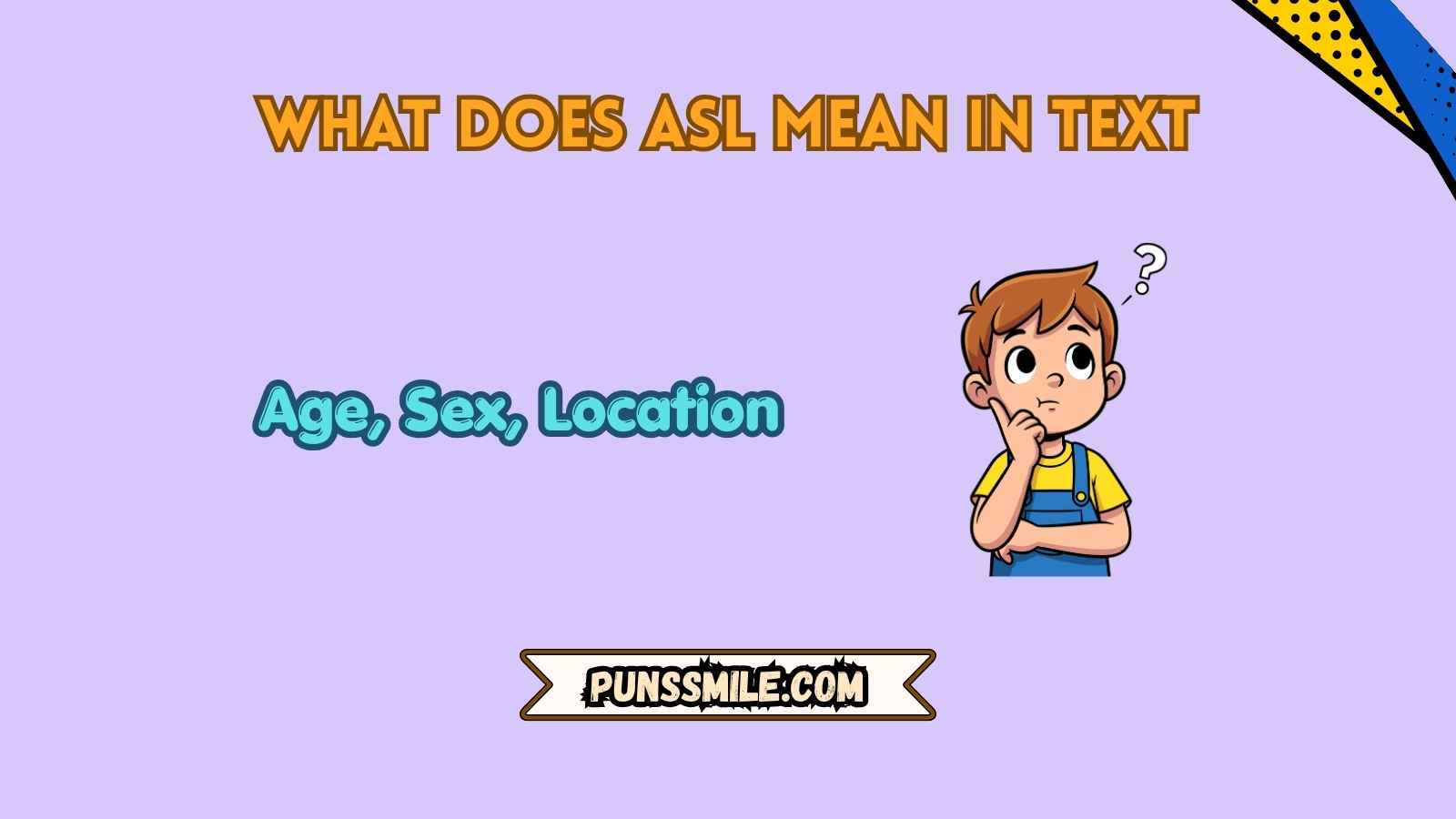
What Does ASL Mean in Text is a common question, especially if you’ve come across the abbreviation in online chats or social media. What does ASL mean in text usually stands for “Age, Sex, Location,” though it can have other meanings depending on the conversation. In this guide, you’ll discover what does ASL mean in text and how it’s used today.
As texting slang continues to evolve, understanding what does ASL mean in text can help you communicate with confidence and avoid confusion. We’ll explain the different meanings, where the term is commonly used, and when it’s appropriate to use it, making this guide simple, informative, and easy to follow.
Meaning & Definition

The abbreviation ASL has several meanings, but the most common one in text messaging is:
Age, Sex, Location
It is a shorthand question asking someone for three basic pieces of information:
- Age – How old are you?
- Sex – Male or female (today, many people may instead interpret or answer this as gender, depending on context.)
- Location – Where do you live?
For example:
Person A: Hi! ASL?
Person B: 23, Female, London.
This abbreviation became popular during the early days of internet chat rooms because typing fewer words made conversations quicker.
However, ASL does not always mean Age, Sex, Location. Other common meanings include:
- American Sign Language
- Above Sea Level
- Advanced Squad Leader
- Automatic Storage and Retrieval-related terms (in industry)
- Various technical abbreviations used in specialized fields
Because ASL has multiple definitions, readers should always consider the surrounding conversation before deciding what the sender intended.
Background
ASL first became widely recognized during the 1990s and early 2000s when online chat rooms, instant messaging services, and internet forums were extremely popular. At that time, users often chatted with strangers from around the world. Since people knew very little about each other, they usually started conversations by asking three simple questions:
- How old are you?
- Are you male or female?
- Where are you from?
Instead of typing the full questions every time, internet users shortened them to ASL.
Platforms where this abbreviation became popular included:
- AOL Instant Messenger
- MSN Messenger
- Yahoo Messenger
- IRC chat rooms
Over time, texting culture evolved. Social media profiles now usually display age, photos, location, or other personal details, making the original use of ASL less common than it once was.
Meanwhile, newer meanings became increasingly popular. For example, American Sign Language gained greater public awareness through education, accessibility initiatives, and social media creators who teach sign language. As a result, younger users may immediately think of sign language rather than the older internet slang.
Today, the abbreviation remains relevant because different online communities continue to use it in different ways.
Usage in Different Contexts
The meaning of ASL changes depending on where it appears.
Casual Texting
In private conversations, ASL often means:
Age, Sex, Location
Example:
“Hey! ASL?”
The sender is simply asking for basic personal information.
Social Media
On platforms like Instagram or Facebook, ASL may refer to:
- American Sign Language
- Age, Sex, Location (less common)
Example:
“I’m learning ASL.”
Here it clearly refers to sign language.
Gaming
Gamers occasionally use ASL when getting to know teammates.
Example:
“ASL before we join voice chat?”
Although not as common today, some gaming communities still use it.
Educational Context
Teachers and students often use ASL to mean:
American Sign Language
Example:
“I’m taking ASL classes this semester.”
Accessibility
Organizations discussing accessibility usually use ASL to refer to communication for Deaf or hard-of-hearing individuals.
Example:
“The event includes an ASL interpreter.”
Professional Fields
Outside internet slang, ASL frequently represents technical or industry-specific terms. Professionals rely on context rather than assuming it means Age, Sex, Location.
Meaning in Chat, WhatsApp, Instagram, and TikTok
Different social platforms have influenced how people interpret ASL.
Chat Messages
In casual chat, ASL generally means:
Age, Sex, Location
Someone may ask:
“Hi! ASL?”
This is simply a conversation starter.
On WhatsApp, ASL usually carries the same meaning as traditional texting.
Example:
“ASL?”
Possible reply:
“24, Male, Canada.”
Among friends, however, it might also refer to American Sign Language if discussing education or accessibility.
Instagram users more commonly use ASL when discussing sign language.
Examples:
- Learning ASL
- ASL tutorials
- ASL interpreter
- ASL alphabet
Since Instagram contains educational content, this interpretation has become increasingly common.
TikTok
TikTok has greatly increased awareness of American Sign Language.
Popular videos include:
- Learning signs
- Everyday vocabulary
- Deaf creators
- Sign language challenges
Therefore, ASL on TikTok frequently refers to sign language rather than the old chat abbreviation.
Snapchat
On Snapchat, ASL still sometimes means Age, Sex, Location, especially when strangers begin conversations.
Meaning in Physics, Medical, and Aircraft Terminology
Although many people associate ASL with texting, professionals use the abbreviation differently.
Physics
In scientific discussions, ASL may stand for:
Above Sea Level
This measurement indicates elevation or altitude relative to mean sea level.
Example:
“The observatory is 2,500 meters ASL.”
This usage is common in geography, meteorology, and environmental science.
Medical Field
Medical professionals may use ASL as an abbreviation for different terms depending on the organization, specialty, or documentation system. Because medical abbreviations vary between hospitals and countries, the exact meaning should always be confirmed from the surrounding context rather than assumed.
Aircraft and Aviation
In aviation, ASL usually means:
Above Sea Level
Pilots use this reference when discussing altitude.
Example:
“The aircraft is flying at 10,000 feet ASL.”
This helps ensure standardized altitude measurements across different locations.
Common Misconceptions
Many misunderstand ASL because they assume it always has one definition.
Some common misconceptions include:
It Always Means Age, Sex, Location
This was true decades ago in internet chat rooms but is no longer universally correct.
It Always Means American Sign Language
While this interpretation is extremely common today, especially in educational settings, it is not the only meaning.
It Is Used Only by Teenagers
People of many ages encounter ASL in professional, educational, and technical environments.
It Is Outdated
Although the classic chat meaning is less common, the abbreviation itself remains widely used in different fields.
Understanding the surrounding conversation is the key to interpreting ASL correctly.
Similar Terms & Alternatives
Several abbreviations serve similar purposes in online communication.
Some alternatives include:
- A/S/L – Same meaning with slashes
- Intro? – Asking someone to introduce themselves
- Bio? – Asking about personal information
- Where are you from?
- How old are you?
- Tell me about yourself
Modern conversations often favor complete questions over abbreviations because they sound friendlier and more natural.
How to Respond to It
Your response depends on what the sender means.
If They Mean Age, Sex, Location
Reply only if you feel comfortable sharing personal information.
Example:
“22, Male, New York.”
Or simply say:
“I’d rather not share personal details.”
Both responses are perfectly acceptable.
If They Mean American Sign Language
You might respond with:
- “Yes, I’m learning ASL.”
- “I know basic ASL.”
- “I’m taking ASL classes.”
If You’re Unsure
The safest response is:
“What do you mean by ASL?”
This prevents misunderstandings.
Differences from Similar Words
ASL differs from many internet abbreviations because it has several unrelated meanings.
| Abbreviation | Common Meaning | Typical Use |
|---|---|---|
| ASL | Age, Sex, Location or American Sign Language | Chat, education, accessibility |
| BRB | Be Right Back | Messaging |
| LOL | Laugh Out Loud | Casual conversations |
| IMO | In My Opinion | Opinions |
| IDK | I Don’t Know | Everyday texting |
| DM | Direct Message | Social media |
| TBH | To Be Honest | Informal discussions |
Unlike most abbreviations, ASL requires context before its meaning becomes clear.
Relevance in Online Conversations & Dating Apps
Although dating apps now include detailed user profiles, ASL still appears occasionally.
Some users send:
“ASL?”
to quickly learn basic information before continuing the conversation.
However, many people now prefer asking complete questions because they feel more polite and conversational.
Examples include:
- “How old are you?”
- “Where are you from?”
- “What city do you live in?”
On modern dating platforms, using full sentences generally creates a better first impression than relying on old internet abbreviations.
Beyond dating, ASL remains relevant because it also represents American Sign Language, a language used by Deaf communities. Social media has significantly increased awareness of sign language through educational videos, interpreters, and accessibility initiatives, making this meaning more familiar than ever.
Conclusion:
The answer to “what does ASL mean in text” depends entirely on context. Traditionally, ASL stood for Age, Sex, Location, a popular conversation starter during the early days of internet chat rooms. While this meaning still appears occasionally in text messages, gaming communities, and dating apps, today’s internet users also widely recognize ASL as American Sign Language, especially on educational platforms and social media. Additionally, professionals use ASL in fields such as aviation, geography, and science to mean Above Sea Level, while healthcare and other industries may use the abbreviation for specialized terms.
Whenever you encounter ASL, consider the topic, platform, and surrounding conversation before deciding its meaning. If the context is unclear, asking for clarification is the simplest and most accurate approach. Understanding these different uses ensures smoother communication and helps prevent misunderstandings in both casual and professional conversations.

Rashid Ali is the mind behind Punssmile.com, where confusing slang and viral terms become simple to understand. He loves breaking down text meanings, chat abbreviations, and trending words in a fun, easy way. If you’ve ever wondered what a word really means in a message, you’re in the right place.