If you’ve ever heard a singer suddenly jump from a low voice to a high one in a quick, ringing pattern, you’ve probably heard a yodel.
But what exactly does yodel mean, and why is this unusual vocal style associated with mountains, folk music, and country songs?
The yodel meaning is straightforward: to sing or call using rapid changes between the natural voice and falsetto or head voice.
The word can also refer to the distinctive sound or style produced by this technique.
Although yodeling is strongly connected with Alpine traditions, it has appeared in many musical cultures and modern entertainment.
Quick Answer:
Meaning: A yodel is a vocal sound or song made by quickly switching between different vocal registers, especially the chest voice and falsetto or head voice.
Definition: To yodel means to sing or call with rapid changes in pitch and vocal register, often creating a distinctive “yo-de-le-ee” type of sound.
Context: Yodeling is commonly associated with Alpine folk traditions, country music, folk songs, and playful vocal performances.
Usage: The word can be used as a noun or a verb. Someone can yodel, or they can perform a yodel.
Tone: Usually musical, traditional, playful, cheerful, or distinctive.
Formal or informal: The word itself is standard English, although the act of yodeling is often discussed in informal, musical, or cultural contexts.
Alternative meanings: In the UK, Yodel can also refer to a parcel delivery company. That meaning is unrelated to the musical technique.
What Is the Definition of Yodel?
The basic yodel definition describes a form of singing or calling that involves quick changes between vocal registers. Instead of staying in one continuous vocal range, the performer deliberately moves between lower and higher sounds.
A yodel often has a noticeable rhythmic and pitch pattern. The sudden vocal changes give it a sound that is very different from ordinary singing.
For example, a person might sing a lower note and then rapidly jump to a much higher note before returning to the lower register. Repeating that pattern can create the recognizable sound associated with yodeling.
The word can describe both the action and the sound itself. You might say, “She learned to yodel,” or “We heard a loud yodel from the hillside.”
In simple terms, yodeling is controlled vocal switching used to create a distinctive musical sound.
Is Yodel a Slang Word, Acronym, or Dictionary Word?
Yodel is a standard dictionary word, not a slang abbreviation or acronym.
It belongs primarily to the vocabulary of music, singing, folk culture, and vocal performance. Unlike texting terms such as “LOL” or “BRB,” it does not have a hidden internet meaning that users normally expect in casual messages.
The word can function as both a verb and a noun.
As a verb:
- “He likes to yodel.”
- “She learned how to yodel.”
- “The singer yodeled during the performance.”
As a noun:
- “We heard a yodel in the distance.”
- “His yodel was surprisingly clear.”
- “The song includes a short yodel.”
So when someone searches for yodel meaning, they are usually looking for the ordinary dictionary definition rather than modern texting slang.
Where Does the Word Yodel Come From?
The word yodel comes from German, particularly the dialectal word jodeln, meaning to sing or call in a yodeling style.
Yodeling became especially associated with the Alpine regions of Central Europe, including Switzerland and Austria. In mountainous areas, vocal calls could carry across long distances, making this style useful for communication as well as musical expression.
Over time, yodeling became an important part of regional folk traditions. It was performed for entertainment, celebrations, social gatherings, and musical performances.
The technique later spread beyond its Alpine roots. It became particularly recognizable in some forms of American country and western music, where singers incorporated yodeling into songs as a distinctive vocal feature.
That history explains why the word yodel can evoke very different settings—from an Alpine mountainside to an American country stage.
What Does Yodeling Sound Like?
Yodeling is recognizable because of its rapid movement between lower and higher vocal sounds.
A simplified example might sound like:
“Yo-de-le-ee-yo!”
That spelling is only an approximation. A real yodel depends on pitch, rhythm, vocal technique, and the singer’s style.
The defining feature isn’t the particular syllables. It is the rapid change in vocal register.
A yodel can therefore sound:
- Bright and energetic
- High-pitched and ringing
- Rhythmic
- Playful
- Echoing
- Traditional or folk-inspired
The exact sound varies considerably from one performer and musical tradition to another.
Yodel Meaning in Music
In music, a yodel is a vocal technique rather than simply a random shout or unusual singing sound.
A singer uses controlled changes in vocal register to produce the characteristic effect. This can be incorporated into an entire song or used briefly as a musical flourish.
Yodeling can serve several purposes. It may create a strong cultural identity, imitate traditional folk styles, add energy to a performance, or simply give a singer a distinctive sound.
In country music, for example, yodeling has been used as a recognizable stylistic element. In Alpine music, it has a much deeper connection with regional traditions and historical forms of singing and communication.
Therefore, the yodeling meaning in music depends partly on context. It can be a traditional technique, an artistic effect, or a recognizable genre characteristic.
Yodel Meaning in Different Contexts
The word stays relatively consistent in meaning, but its context can change how it is understood.
| Context | Meaning of Yodel |
|---|---|
| Music | A vocal technique using rapid register changes |
| Alpine folk culture | A traditional form of singing or calling |
| Country music | A distinctive vocal style used in songs |
| Everyday conversation | To make or sing a yodeling sound |
| Humor | An exaggerated or playful singing sound |
| UK business context | Yodel may refer to a parcel delivery company |
The musical meaning is by far the most common when someone asks about the word in a dictionary or language context.
How Is Yodel Used in a Sentence?
Here are some natural examples of yodel in everyday English:
“The singer began to yodel during the final verse.”
Here, yodel describes a musical vocal technique.
“We heard someone yodeling across the valley.”
In this sentence, the word describes a vocal call that carries over a distance.
“He learned to yodel for the folk music performance.”
This refers to practicing the technique as part of a traditional style.
“The cartoon character let out a ridiculous yodel.”
Here, the word is being used humorously to describe a playful vocal sound.
“That country song features some impressive yodeling.”
In this example, yodeling is being used as a musical characteristic.
These examples show that the word can fit both serious musical contexts and casual, humorous situations.
What Is the Difference Between Yodeling and Singing?
Yodeling is a type of vocal performance, so it is related to singing but isn’t exactly the same thing.
Ordinary singing can remain within a relatively consistent vocal register and move smoothly between notes. Yodeling is characterized by quick, noticeable changes between vocal registers.
| Yodeling | Ordinary Singing |
| Rapidly changes vocal register | Often maintains a smoother vocal transition |
| Produces a distinctive break or contrast | Usually aims for continuous vocal phrasing |
| Strongly associated with certain folk traditions | Found across virtually all musical genres |
| Can be used as a special vocal effect | Forms the basic vocal method of most songs |
| Often has a recognizable rhythmic pattern | Can use many different rhythmic patterns |
The two can also be combined. A singer can perform an ordinary melody and introduce yodeling for emphasis or style.
Is Yodeling Only From Switzerland?
No. Switzerland is strongly associated with yodeling, but it is not accurate to treat yodeling as belonging exclusively to one country.
The technique has deep roots in Alpine regions, particularly traditions associated with Switzerland and Austria. Different communities developed their own forms, purposes, and styles.
Yodeling has also appeared in other parts of the world and eventually became part of musical traditions outside Europe.
In the United States, for instance, yodeling became connected with country and western music. American performers adapted the technique into their own musical styles rather than simply reproducing European traditions.
So, when people think of yodeling as “Swiss,” they are recognizing an important cultural association, but the broader history is more varied.
Yodeler Meaning
A yodeler is a person who yodels.
The term can describe someone who performs yodeling professionally, participates in folk music, or simply knows how to use the technique.
For example:
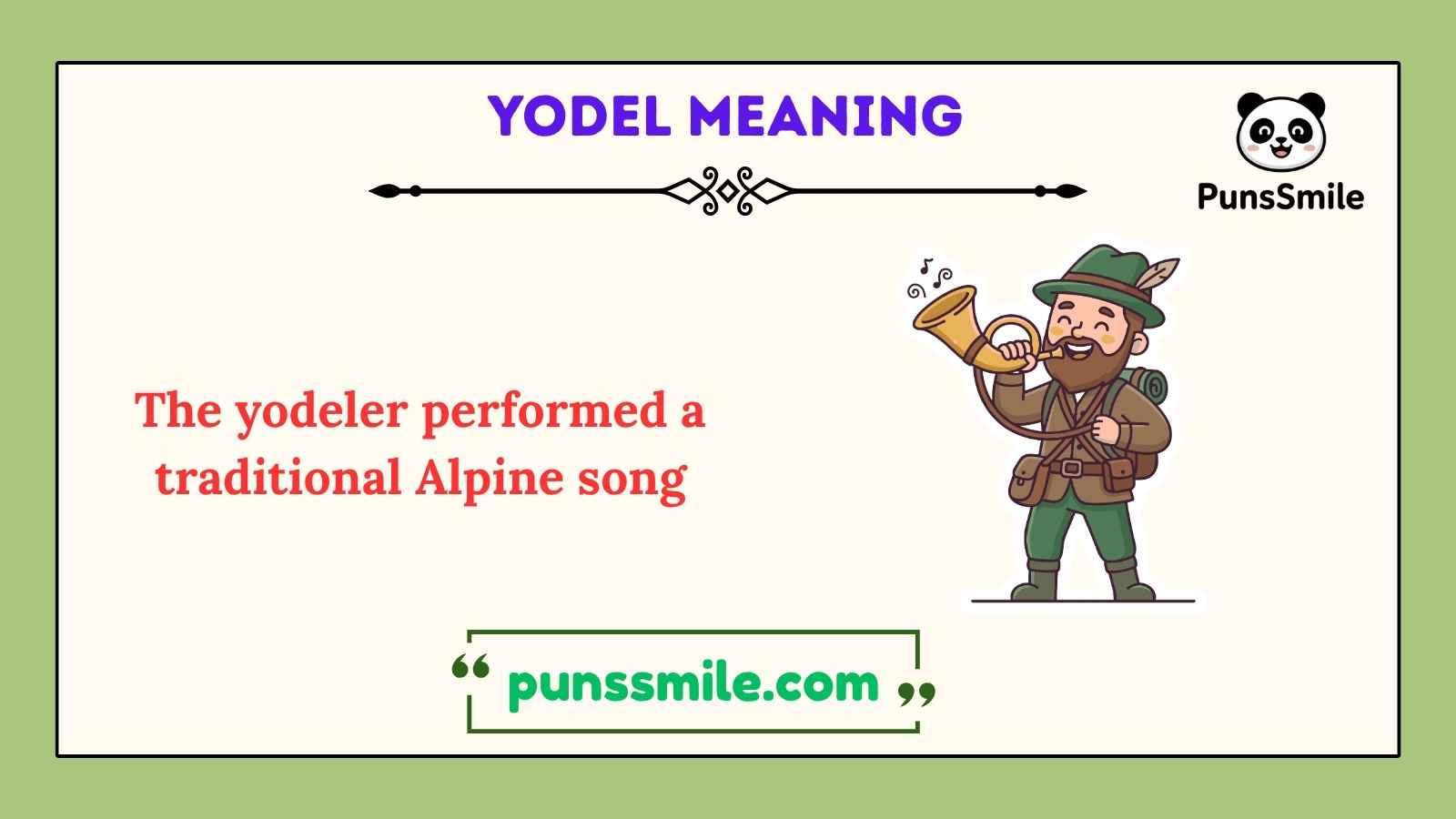
“The yodeler performed a traditional Alpine song.”
Here, yodeler simply means a person who performs yodeling.
You may also see the spelling yodeller, particularly in British English. Both forms refer to someone who yodels, although yodeler is common in American English.
Yodel vs. Yodeling vs. Yodeler
These related words are easy to distinguish:
- Yodel — the sound, song, or act of producing the distinctive vocal effect.
- Yodeling — the activity or technique of producing yodels.
- Yodeler — the person who yodels.
For example:
“The yodeler was yodeling a traditional song, and her yodel was easy to recognize.”
Each word has a slightly different grammatical role, but they all come from the same basic concept.
Is Yodeling Hard to Learn?
Yodeling can be challenging because it requires control over pitch and vocal registers.
The distinctive register change needs to happen quickly and accurately. A beginner may initially produce an unstable or forced sound rather than a controlled yodel.
Learning the technique generally involves developing vocal control rather than simply shouting high and low notes.
A useful distinction is that yodeling should not mean forcing the voice. Good vocal technique matters, particularly when practicing repeated register changes.
Professional singers may develop specialized techniques for making the transitions smooth, controlled, and musical.
Common Misunderstandings About Yodel
One common mistake is assuming that any loud or high-pitched singing is yodeling. That isn’t necessarily true.
Another misconception is that the syllables “yo-de-le-ee” themselves define a yodel. They are commonly used to imitate the sound, but the syllables aren’t what makes the technique a yodel.
It is also easy to assume that yodeling is exclusively Swiss. Switzerland is certainly one of its best-known cultural homes, but Alpine yodeling has a broader regional history.
Finally, Yodel can have a completely different meaning in a business context in the United Kingdom, where it is the name of a parcel delivery company. Context determines which meaning is intended.
When Should You Use the Word Yodel?
Use yodel when you are talking about a distinctive vocal technique, sound, or performance.
It works naturally in conversations about:
- Singing
- Folk music
- Country music
- Alpine traditions
- Vocal techniques
- Musical performances
- Humorous singing sounds
For example:
“The performer knows how to yodel.”
That sentence is natural because it describes a specific vocal ability.
If you’re discussing a person, yodeler is usually the better choice:
“The yodeler performed an Alpine folk song.”
When Should You Not Interpret Yodel as a Musical Term?
Context matters when the word appears as a proper name.
If someone in the United Kingdom says they are “waiting for Yodel,” they may be talking about the delivery company rather than singing.
Similarly, a brand, username, product, song title, or fictional character could use Yodel as a name without referring to the vocal technique.
The surrounding words usually make the intended meaning clear.
For example:
“I need to track my Yodel delivery.”
This obviously points toward the company.
By contrast:
“She started to yodel on stage.”
This clearly refers to the vocal technique.
Yodel Pronunciation
In standard English, yodel is commonly pronounced roughly like:
YOH-dəl
The first syllable sounds like “yo,” while the second is a short, unstressed sound similar to “duhl.”
The pronunciation may vary slightly between accents, but the word is generally easy to recognize when spoken.
The related word yodeling is pronounced roughly as:
YOH-dəl-ing
Learning the pronunciation is useful if you’re discussing the term in a music, language, or cultural setting.
FAQs:
What does yodel mean in simple words?
Yodel means to sing or call by quickly changing between different vocal registers, especially lower and higher sounds.
Is yodel a slang word?
No. Yodel is a standard English dictionary word, primarily associated with singing, vocal technique, and folk music.
What is a yodel in music?
A yodel is a vocal technique in which the singer rapidly switches between vocal registers, creating a distinctive high-and-low sound.
Where did yodeling originate?
Yodeling has deep historical roots in Alpine regions of Central Europe, particularly traditions associated with Switzerland and Austria.
What is a person who yodels called?
A person who yodels is called a yodeler. The spelling yodeller is also used, particularly in some varieties of British English.
Is yodeling the same as singing?
Yodeling is a form of vocal performance, but it differs from ordinary singing because it prominently features rapid changes between vocal registers.
Does Yodel have another meaning?
Yes. Yodel can also be the name of a UK parcel delivery company. That business meaning is separate from the musical term.
Why do people yodel?
Historically, yodeling could be used for communication across mountainous landscapes and for social or musical purposes. Today, it is primarily associated with music, cultural traditions, and performance.
Final Takeaway:
The yodel meaning is simple once you understand the vocal technique: to yodel is to sing or call with rapid changes between vocal registers, producing a distinctive high-and-low sound.
The word is a standard English term rather than slang or an acronym.
Its strongest cultural associations are with Alpine folk traditions, especially Switzerland and Austria, although yodeling later became part of other musical traditions, including American country music.

Rashid Ali is the mind behind Punssmile.com, where confusing slang and viral terms become simple to understand. He loves breaking down text meanings, chat abbreviations, and trending words in a fun, easy way. If you’ve ever wondered what a word really means in a message, you’re in the right place.