Industrial process engineers speak a dialect all their own, filled with technical jargon that sounds precise and clinical. But beneath the surface of reactor specifications and flow diagrams lies an unexpected truth: the language of chemical processing is surprisingly riddled with visual metaphors, double meanings, and linguistic shortcuts that would delight any lover of wordplay. From “plug flow” to “dead zones,” the terminology of reactor design reveals how engineers have borrowed everyday language and twisted it into technical precision.
The Poetry Behind Process Equipment Names
Walk through any chemical plant and you’ll encounter equipment with names that sound more like science fiction than engineering. The “fluidized bed” conjures images of particles dancing in suspension, which is exactly what happens when gas flows upward through solid catalyst particles at just the right velocity. A “packed bed” suggests dense organization, and indeed, these reactors contain structured arrangements of catalyst pellets stacked to maximize surface area while minimizing pressure drop.
Then there are “bubble columns,” where gas bubbles rise through liquid like champagne, creating three-phase contact between gas, liquid, and catalyst. The visual metaphor embedded in the name helps operators and engineers instantly grasp the physical behavior inside, even if they’ve never seen inside the vessel. This linguistic efficiency matters when troubleshooting a process upset at three in the morning.
Reactor Terminology and Its Unexpected Echoes
The “stirred tank” might sound mundane until you consider that entire doctorate dissertations have been written about impeller design and mixing patterns within these vessels. Engineers debate whether “radial flow” or “axial flow” impellers work better for specific applications, creating tribal camps within the profession that take their stirring seriously.
Continuous reactors introduce their own vocabulary. The term “residence time distribution” sounds technical, but it describes something fundamentally human: how long different molecules stay at the party. Some zip through quickly while others linger, and this variation in social behavior—or rather, hydraulic behavior—determines product quality and conversion efficiency.
Tubes, Pipes, and the Flow of Language
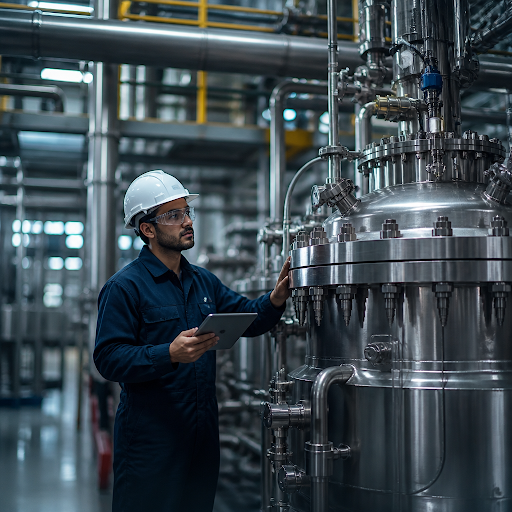
When chemical engineers need continuous processing with minimal back-mixing and excellent heat transfer, they often turn to elongated vessel designs where reaction occurs as materials flow through. For operations requiring precise temperature control and high conversion rates, a tubular reactor provides the necessary combination of plug flow characteristics and heat exchange surface area. These vessels exemplify how form follows function in process design, with their length-to-diameter ratios carefully calculated to achieve specific reaction kinetics while managing exothermic heat release.
The beauty of tubular designs lies in their predictability. Unlike batch reactors where conditions change over time, or stirred tanks where perfect mixing occurs, tubular configurations create a spatial gradient. Reactants enter at one end with maximum concentration, and conversion increases steadily along the length. This axial progression makes modeling straightforward and scale-up more reliable than many alternatives.
Cross-Cultural Engineering and Linguistic Bridges
Process engineering has always been an international discipline, and with globalization, teams increasingly span multiple languages and cultures. The technical vocabulary serves as a universal language, but misunderstandings still arise. When a German engineer discusses “Rührkessel” or a Chinese colleague mentions “搅拌釜,” they’re both describing stirred vessels, but the cultural context shapes how they approach process design.
This linguistic diversity extends beyond technical terms into humor and informal communication. Engineers working across borders discover that wordplay, puns, and linguistic creativity help build team cohesion. The ability to appreciate clever language constructions from different cultures can actually improve professional relationships and project outcomes, as it signals cultural competence and openness to different thinking styles.
Automation and the Changing Language of Process Control
Modern chemical plants increasingly rely on distributed control systems and automated monitoring, which introduces yet another vocabulary layer. Terms like “cascade control” and “feed-forward compensation” describe sophisticated strategies for maintaining reactor conditions within tight specifications. Plant operators now speak in terms of “setpoints” and “process variables” rather than simply watching gauges and adjusting valves manually.
This evolution toward automation has transformed how engineers communicate about reactor performance. Facilities upgrading to modern control systems find that their teams must learn new terminology alongside new technology. The language shifts from physical descriptions—”open that valve a quarter turn”—to abstract commands in software interfaces. Yet the fundamental goal remains unchanged: precise control of temperature, pressure, flow, and composition to achieve optimal reaction conditions.
Metaphors That Shape Engineering Thinking
Beyond specific equipment names, process engineers use metaphorical language to conceptualize complex phenomena. They speak of “mass transfer limitations” as if molecules face bureaucratic obstacles. “Diffusion barriers” suggest physical walls rather than concentration gradients. “Reaction fronts” move through fixed beds like advancing armies, consuming reactants and leaving products behind.
These metaphors aren’t mere linguistic decoration. They shape how engineers mentally model processes and identify solutions. When someone describes a reactor as “starved for oxygen,” the metaphor immediately suggests potential remedies: increase gas flow, improve mixing, reduce liquid viscosity, or add more impellers. The anthropomorphization of chemical equipment makes complex systems more intuitive and troubleshooting more accessible.
The Evolution of Process Language
As industries adopt new technologies and methodologies, the language adapts. “Continuous manufacturing” has largely replaced “continuous processing” in pharmaceutical contexts, reflecting regulatory and business concerns rather than technical changes. “Intensified processes” and “modular equipment” represent newer concepts focused on efficiency and flexibility.
Sustainability initiatives have introduced terms like “green chemistry” and “circular economy” into reactor design discussions. Engineers now routinely discuss “carbon footprint” and “life cycle analysis” alongside traditional metrics like yield and selectivity. This linguistic evolution reflects changing priorities in the chemical industry, where environmental performance increasingly drives equipment selection and process optimization.
Finding Precision in Playful Language
The intersection of technical precision and linguistic creativity reveals something essential about engineering culture. Despite stereotypes of engineers as purely analytical and humourless, the field thrives on clever communication, memorable mnemonics, and yes, even puns. Students learn to remember that “PFR” means plug flow reactor using various memory devices, some more suitable for publication than others.
This playfulness serves a purpose. In high-stakes environments where miscommunication can mean safety incidents or production losses, memorable language helps ensure critical information sticks. When a senior engineer tells you that a particular reactor “doesn’t like rapid startups,” that anthropomorphic warning is more memorable than a detailed explanation of thermal stress and metallurgical limitations. The informal language complements formal documentation, creating redundancy that improves safety and reliability.
Whether you’re selecting equipment for a new plant, troubleshooting an existing process, or simply trying to understand how chemical manufacturing works, paying attention to the language reveals deeper insights. The words engineers choose reflect decades of collective experience, hard-won lessons, and a recognition that precision and playfulness need not be mutually exclusive. After all, even the most serious chemical processes benefit from clear, memorable, and occasionally clever communication.
Read more: https://punssmile.com/how-to-prevent-costly-home-plumbing-repairs/
https://punssmile.com/how-to-dry-your-hair-without-unnecessary-damage/