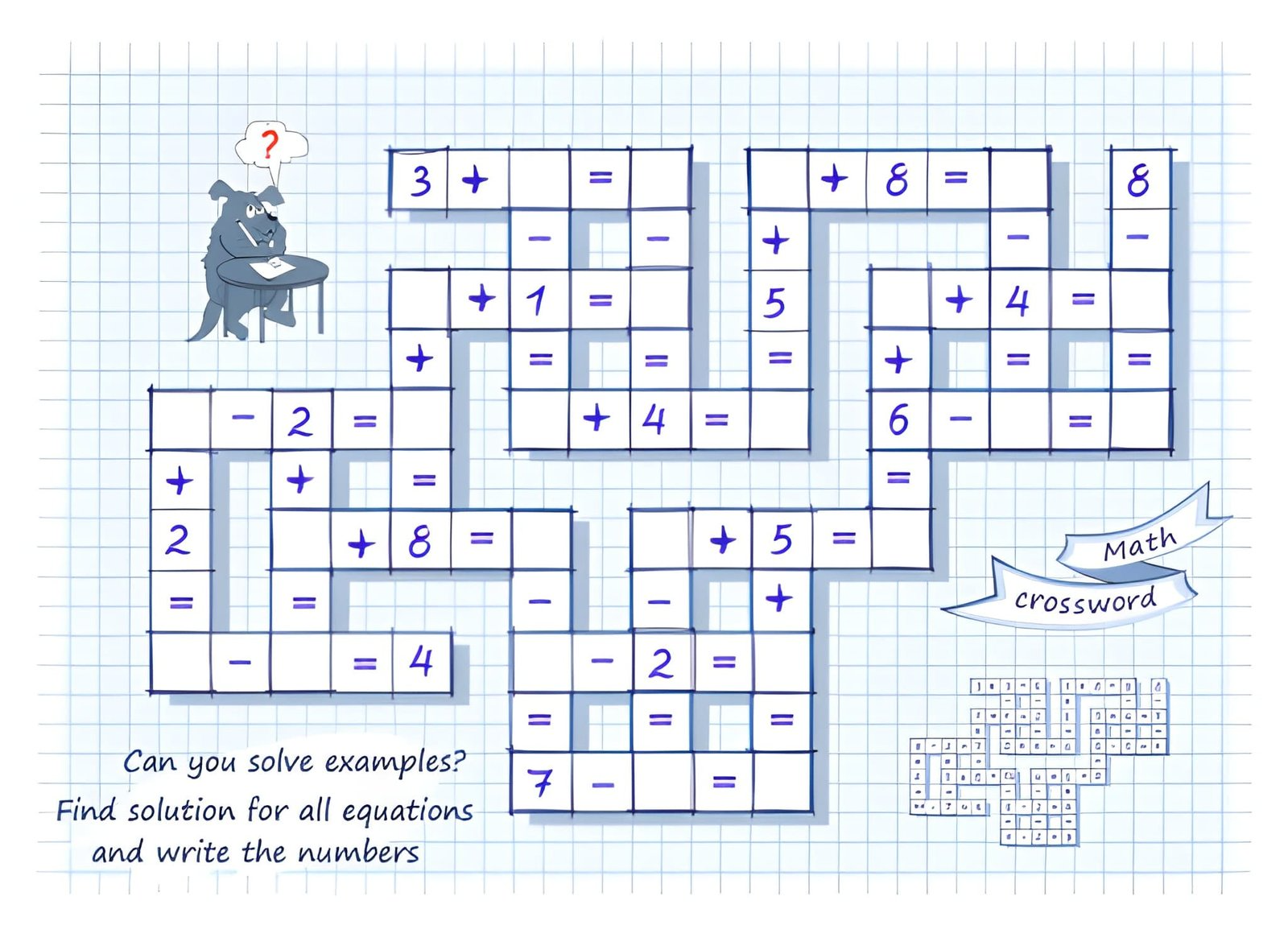
Most of us stopped practising arithmetic the day we were allowed a calculator, and it shows: split a restaurant bill or work out a discount in your head and there’s a noticeable pause where the answer used to be instant. The usual fix — drilling with flashcards or an app that fires sums at you — works, but it’s dull enough that almost nobody sticks with it. There’s a much more enjoyable route, and it’s built like a puzzle rather than a test.
The problem with drilling
Flashcard-style practice has one structural flaw: it’s isolated. Each sum is a standalone question, answered and forgotten. That’s fine for memorising times tables, but it doesn’t build the thing you actually use in daily life — holding a few numbers in mind at once and reasoning about how they fit together. It also has no momentum. Nothing you solve helps you solve the next one, so it feels like work because it is.
What a math crossword does differently
A math crossword — often called crossmath — turns arithmetic into a connected grid. Rows and columns are equations that share cells, so every digit you place has to satisfy two sums at once. That single change transforms the activity:
- It becomes deduction, not recall. You’re not asked “what is 6 × 7?” — you’re working out which digit can possibly go in a cell given everything around it. That’s the exact mental muscle you use for real-world estimates.
- It has momentum. Placing one correct number constrains its neighbours, which unlocks others. Progress compounds, which is the opposite of the flashcard grind.
- It’s genuinely engaging. The satisfaction of a grid clicking into place is what keeps people doing it voluntarily — and voluntary practice is the only kind that lasts.
The arithmetic stays gentle on purpose
An important detail: the sums in a good crossmath are small. Single digits, the four basic operations, nothing intimidating. The challenge is entirely in the logic, which means you’re getting the mental-arithmetic reps without ever feeling like you’re being tested. It’s practice disguised as a game, which is precisely why it works where drills fail.
Building the habit
If you want the benefit, the pattern is the same as any skill:
- Short and regular beats long and rare — one grid a day is plenty.
- Start small. A compact grid teaches the logic; scale up once the deductions come easily.
- Resist the calculator. The whole value is in doing the small sums in your head.
A free math crossword puzzle that runs in the browser — no app, no sign-up, several sizes and difficulties — makes the daily grid easy to fit in wherever you have a few spare minutes. Open, solve, close.
The payoff
Sharp mental arithmetic isn’t about being fast at sums; it’s about numbers feeling familiar again, so that estimates and quick checks come naturally. A puzzle that makes you reason with numbers every day rebuilds that familiarity far more pleasantly than any drill — and, unlike the flashcards, you’ll actually keep doing it.
Read more: Why the Oldest Magic Cards Play By Completely Different Rules – punssmile.com
Exchange Bitcoin (BTC) for Litecoin (LTC)
Coveted Meaning Learn When and How to Use It Clearly





5 thoughts on “Why a Math Crossword Beats Flashcards for Keeping Your Mental Arithmetic Sharp”