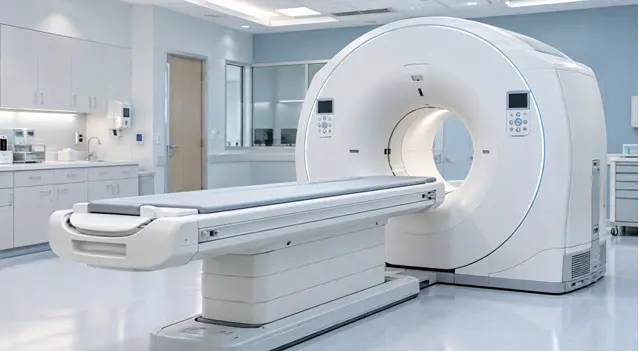
A CT scan usually arrives before the explanation does. You leave with a disc, a download link or a folder of images, and the part that matters most, what all of this means for you, is still somewhere in a queue. Remote reporting exists to close that gap: it takes the study you already have and puts it in front of a radiologist who has the time and the right background to read it properly, wherever you happen to live.
What “remote” actually means
Nothing about the examination itself changes. The scan stays exactly as it was recorded at your hospital or imaging centre, in the standard DICOM format every CT scanner produces. What changes is the route it travels. Instead of waiting for a local slot, you send the study through a secure upload and it reaches a radiologist who works through it slice by slice, at full diagnostic quality. The distance is purely administrative: what appears on the radiologist’s screen is your original series, not a compressed preview or a set of screenshots. That is the whole idea behind a service such as https://eurodiagnosis.eu/produkt/ct-scan-report/, where the study you already hold becomes the starting point instead of a new appointment.
Who sits at the other end
Every case at Eurodiagnosis is read by an actively practising radiologist, never by an algorithm and never by a doctor still in specialist training. The study is also matched to the right person: a chest CT and a CT of the lumbar spine call for different daily experience, so your images go to a subspecialist who reads that region routinely. Every visible structure is assessed and documented, including the ones you did not come in asking about, with size, location, morphology and clinical significance described for anything that stands out.
From upload to finished report
The sequence is short and predictable:
- You upload the study in DICOM, with a short note on symptoms and any earlier reports.
- The case is assigned to a radiologist with the relevant subspecialty.
- The images are reviewed independently, rather than simply following the previous description.
- You receive a written report: image description, interpretation, likely diagnoses ordered by probability, and recommended next steps.
A standard turnaround is a matter of days, with an urgent option for situations where a decision cannot wait for the usual schedule. If something needs prompt attention, you hear about it quickly instead of discovering it buried in the text.
Why this beats looking for answers on your own
Typing a phrase from a report into a search engine returns the whole spectrum of possibilities, with no way of telling which one fits your images. A radiologist works from your anatomy, your measurements and your findings, and writes in language you can follow while keeping the document clinically useful for the doctor treating you. That is the difference between reading about a condition and understanding your own scan. It is also the difference between a long evening of guesswork and a document you can take to your appointment, where the important findings are already summarised and put in order.
Worth remembering
A remote CT report does not replace your treating physician. It gives both of you a second careful reading and a clear document to work from, usually sooner than a local appointment allows, and in wording you do not need a medical degree to follow. If your report left questions open, if the case is complicated, or if an operation is being planned, an independent review is a sensible next step, and one you can arrange without waiting for a referral.
Also Read
- everyday-outdoor-food-ideas-for-your-propane-grill/
- discover-cost-effective-solar-power-solutions-for-fredericksburg-properties/
- dont-neglect-your-teeth-the-dangers-of-poor-oral-hygiene/